

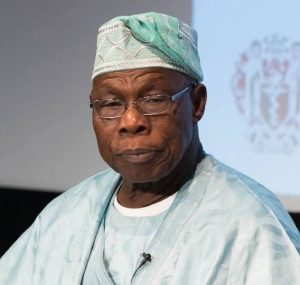
Olusegun Obasanjo’s escalating warnings about Bola Tinubu are not the ramblings of a bitter rival. They are the precisely calibrated signals of a man who has read this country’s entrails for six decades — and does not like what he sees.
Opinion | Kio Amachree The author is President of Worldview International, a Stockholm-based civic platform, and a Nigerian diaspora commentator.
I write this from Stockholm. I listen carefully. I watch. And I am not fooled.
There is a pattern emerging from the sidelines of Nigerian politics that deserves far more serious international attention than it has received. Olusegun Obasanjo — former military head of state, two-term civilian president, survivor of Abacha’s prison, architect of Nigeria’s debt relief, and quite possibly the most politically intelligent man that country has produced in the last half-century is raising his voice. He is not shouting. He never shouts. That is precisely why every syllable should be treated as a seismic event.
In recent months, the warnings have been coming with increasing frequency and ferocity. Obasanjo called Tinubu “a complete failure,” declaring that the government is “deep in debt yet spending money like a drunken sailor.” Before that, he stated in an interview that any government that cannot protect the lives and property of its citizens “has forfeited the right of existence” — a nuclear verdict delivered with surgical calm. At a Christmas gathering in Jos, he thundered that “Nigerians are being killed every day” and that if the government cannot protect its people, citizens have the right to call upon the international community.
These are not the complaints of a town crier. This is Obasanjo telegraphing, in the language of Nigerian power, something that the corridors of Abuja already understand: the current arrangement is approaching its end.
Love him or hate him and there are more than sufficient reasons for both — Obasanjo is part of the wiring of the Nigerian state itself. He has been present, consequential, and controversial at every major inflection point of the country’s post-independence history. He was the military leader who, almost uniquely on this continent, voluntarily handed power to a civilian government in 1979. He returned as a civilian president in 1999 and governed for eight years during which, whatever his considerable sins, he is credited with securing Nigeria’s landmark debt relief and establishing anti-corruption institutions that, however imperfect, established a legal architecture that outlasted him. He has survived Sani Abacha’s prison.
He has outlasted every political enemy he has ever made. And now, at eighty-eight years old, he is tearing into Tinubu’s administration with a relentlessness that even his fiercest critics must find difficult to dismiss as mere personal vendetta.
The Tinubu presidency’s response has been telling. Rather than address the substance of Obasanjo’s charges, the president’s spokesman dismissed the former leader’s words as “reckless” and attempted to relitigate history by blaming him for Boko Haram’s early formation — a reach so desperate it tells you everything about the administration’s confidence in its own defence.
Here is what I believe, and I have been observing Nigerian power structures since I was a young man. Obasanjo does not make noise without purpose. The two men have clashed since Tinubu’s days as Lagos governor, when the federal government under Obasanjo withheld the state’s statutory allocations. Their mutual disdain is historical fact. But personal animosity alone does not explain the timing, the escalation, or the particular nature of the current warnings. Something else is in motion.
Obasanjo has always maintained deep institutional relationships with the Nigerian military establishment and the northern power elite. He understands the architecture of consent that governs who actually remains in office in Nigeria, regardless of what any ballot says. When a man of his particular knowledge and connections begins to publicly declare that a sitting president has “no right to exist” in office, he is not merely venting. He is delivering a message — to Tinubu, to the institutions, and to the Nigerian public — that the patience of those who matter most is expiring.
The borrowing has become a particular flashpoint. Obasanjo’s characterisation of the administration as recklessly indebted while officials spend extravagantly has triggered massive reactions across Nigerian social media, with Nigerians sharply divided between those who agree with the diagnosis and those who accuse the former president of the same sins during his own tenure. The fact that this debate is happening at all — that ordinary Nigerians are being forced to compare two administrations on the metric of fiscal recklessness — is itself a damning indictment of the political class as a whole.
But let us not hide behind false equivalence. The issue before Nigeria today is not the quality of Obasanjo’s conscience. The issue is whether Bola Tinubu, with his administration’s record of hardship, insecurity, institutional erosion, and what multiple international observers and Nigerian civil society groups have described as the weaponisation of state security agencies against dissent, should be allowed to consolidate power for a second term. From where I sit, monitoring carefully, the answer that is forming in the deepest structures of Nigerian power — north and south, military and civilian — appears to be: no.
Tinubu may believe that security arrangements, political alliances, and the brute mechanics of electoral manipulation can override this verdict. He may be calculating on the basis of support from powerful international patrons. He may believe that the noise from the diaspora and from men like Obasanjo is inconsequential.
He is making a category error.
The old general is not a street preacher. He is, as I have said before, the needle in every tailor’s pattern. He knows where the cloth will tear before the tailor does. And right now, he is pointing, loudly and repeatedly, at a very specific seam.
Nigeria’s international partners — in Washington, Brussels, London, and the UN system — would do well to listen. Not to Obasanjo’s character, which is complex and contested, but to the substance of what he is saying: that a government incapable of protecting its citizens, drowning in debt it is spending without accountability, and presiding over the systematic dismantling of civic space, does not deserve — and may not survive — a second mandate.
The signals are getting louder. The pattern is clear. I am listening from Stockholm. The question is whether those who have the power to act are paying attention.
Kio Amachree is President of Worldview International and a political commentator whose work appears in Vanguard, Sahara Reporters, and Starconnect Media.

