

A volcano in Russia’s remote Kamchatka Peninsula, Krasheninnikov, has erupted for the first time in more than five centuries, sending an ash plume as high as six kilometres into the atmosphere. According to Russia’s emergency ministry, the eruption does not currently pose a threat to populated areas. The volcano had remained dormant since the 15th century, making the sudden activity highly significant.
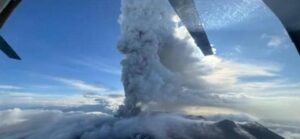
The eruption comes shortly after a powerful 8.8 magnitude earthquake struck the region last week, prompting tsunami warnings across the Pacific as far as French Polynesia and Chile. Experts believe this rare seismic event may have triggered the volcanic activity, as both phenomena occurred within the Pacific “Ring of Fire,” an area known for its intense geological activity.
Adding to the seismic tension, another strong earthquake measuring 7.0 on the Richter scale struck the Kuril Islands just hours after the volcanic eruption. Though the resulting tsunami waves were relatively small—only up to 18cm—Russia’s emergency ministry urged residents in three Kamchatka regions to evacuate coastal zones as a precaution.
Volcanologist Olga Girina confirmed that the Krasheninnikov eruption could be linked to the earlier 8.8 magnitude quake. Russian scientists had previously warned that strong aftershocks were likely to continue for weeks, raising concerns about further geological disturbances. The Kamchatka Peninsula, despite its isolation, remains a critical point of observation due to its placement within the volatile Ring of Fire.

