

In Nigeria’s national statement delivered at the 79th session of the United Nations General Assembly (UNGA) late Tuesday, President Bola Tinubu, made an appeal to global leaders, urging them to prioritize debt forgiveness for Nigeria and other developing nations.
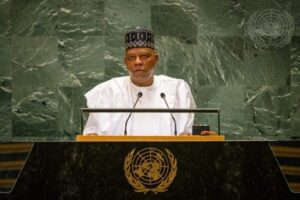
The president emphasized the need for relief from multilateral financial institutions and creditors during the 79th Session of the UNGA in New York.
Represented by Vice President Kashim Shettima, Tinubu stressed that the nations of the Global South cannot achieve meaningful economic progress without concessions on their overwhelming debt burdens.
His call for debt relief and reforms came amid the pressing economic challenges these nations face.
In a press release issued by Stanley Nkwocha, Senior Special Assistant to the President on Media and Communications (Office of the Vice President), the Nigerian leader highlighted to the UN how the global debt crisis is crippling countries’ abilities to address the needs of their citizens.
He also pointed out that trade barriers and protectionist policies are shattering nations’ aspirations, while unchecked competition is stifling motivation and obstructing global investment opportunities.
The Debt Management Office, in its Q1 2024 report, revealed that Nigeria’s total domestic and external debts amounted to ₦121.67 trillion ($91.46 billion).
With state governments seeing a 122% increase in external debt servicing in the first half of 2024, the economic strain has been severe, with Kaduna and Lagos states paying the highest servicing costs.
During the first half of 2024, Nigerian states witnessed a 122% rise in external debt servicing, reaching ₦139.92 billion, up from ₦63.06 billion in 2023.
This increase was driven by escalating borrowing costs due to currency depreciation, which has severely affected state-level spending and fiscal stability.

