

Yakubu Barbara’s Community Influencer Social & Political Commentary.
To understand why the Middle Belt is demanding political recognition, identity and administrative autonomy, we must first understand the historical evolution of Nigeria itself.
A BRIEF HISTORY OF NIGERIA’S FORMATION AND ADMINISTRATIVE EVOLUTION
Before colonialism, the geographical territory now known as Nigeria was made up of several independent kingdoms, empires, chiefdoms and communities with distinct political institutions, cultures, languages and systems of administration. These included the Sokoto Caliphate, Kanem-Borno Empire, Oyo Empire, Benin Kingdom and numerous independent communities across the Middle Belt and other parts of the country.
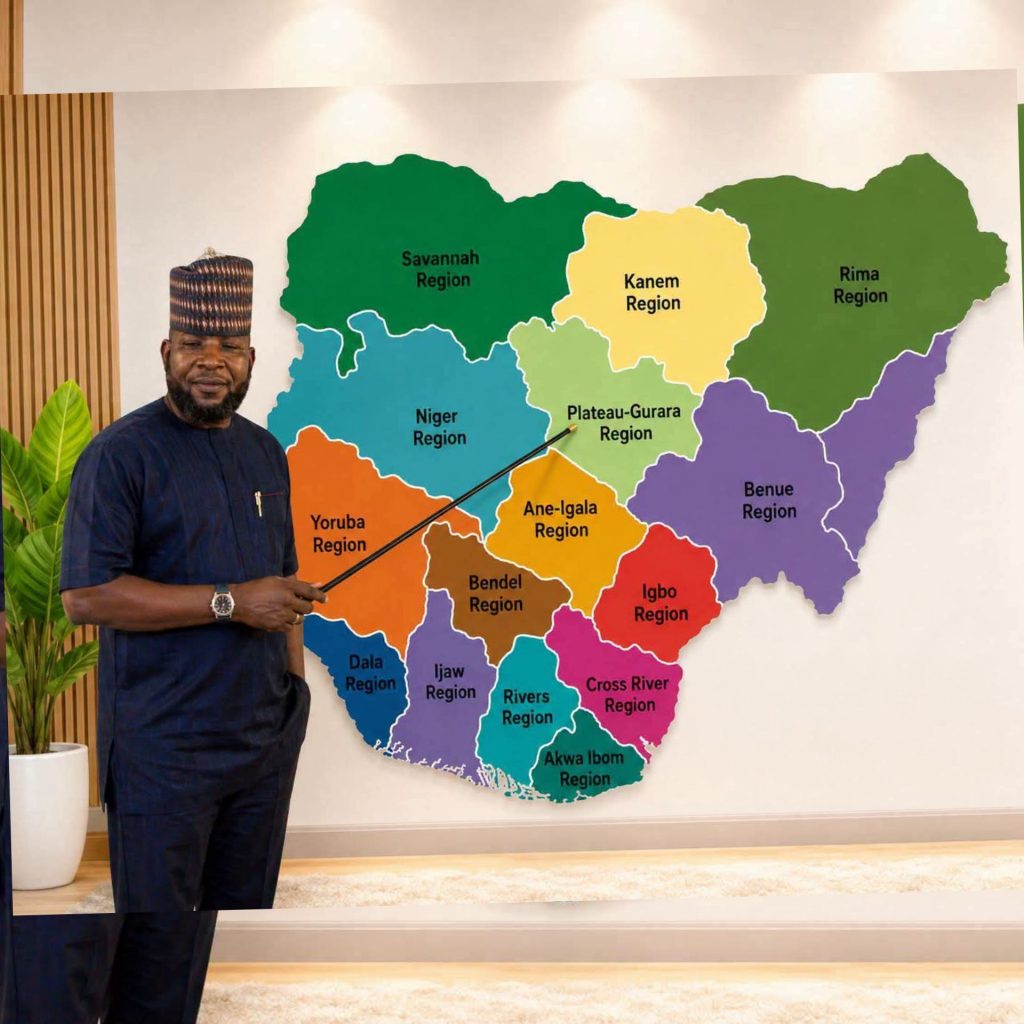
Nigeria, as we know it today, was not originally one political entity.
In 1897, British journalist Flora Shaw proposed the name Nigeria, derived from the River Niger. On January 1, 1914, Lord Frederick Lugard amalgamated the Northern and Southern Protectorates, alongside the Lagos Colony, into one British colonial administrative entity called Nigeria.
Nigeria subsequently evolved through different constitutional and administrative arrangements before gaining independence on October 1, 1960.
THE FIRST REGIONAL STRUCTURE
At independence in 1960, Nigeria operated a federal structure consisting of three regions:
Northern Region.
Western Region.
Eastern Region.
Lagos operated as the Federal Capital Territory.
In 1963, the Mid-Western Region was created out of the former Western Region, bringing the number of regions to four.
Did the creation of the Mid-Western Region divide Nigeria? No. It was an administrative and political restructuring intended to address the aspirations of its people.
THE EVOLUTION OF STATES IN NIGERIA
In 1967, General Yakubu Gowon abolished the regional structure and created 12 states out of the four existing regions.
In 1976, General Murtala Mohammed created seven additional states, bringing the total to 19.
In 1987, General Ibrahim Babangida created two more states, bringing the number to 21.
In 1991, another nine states were created, bringing the total to 30.
In 1996, General Sani Abacha created six additional states, bringing Nigeria to its present 36-state structure.
Today, Nigeria has 36 states and the Federal Capital Territory.
WHAT ABOUT LOCAL GOVERNMENTS?
The story is not different at the grassroots level.
Before the modern local government system, Nigeria operated different forms of Native Authority and local administration under colonial rule.
The 1976 Local Government Reform established a more uniform local government system and created 301 local government areas, strengthening local administration and bringing governance closer to communities.
Subsequent exercises increased the number to 449 in 1989, 589 in 1991 and eventually 774 in 1996.
Today, Nigeria has 774 constitutionally recognised Local Government Areas.
Now, let us ask some fundamental questions:
Did the creation of 12 states in 1967 destroy Nigeria?
Did the expansion to 19, 21, 30 and eventually 36 states disintegrate the country?
Did the creation of 774 local governments automatically turn Nigerians against one another?
Absolutely not!
These developments were part of Nigeria’s continuing search for a more workable administrative and political structure.
WHY, THEN, SHOULD THE MIDDLE BELT’S ASPIRATIONS BE DIFFERENT?
Why should the agitation for a distinct Middle Belt political identity, regional recognition and administrative autonomy suddenly become a threat to national unity?
Why should the desire of Middle Belt people to determine their political future, preserve their identity, protect their interests and enjoy equitable representation be interpreted as an attempt to divide the country?
Why should some people, particularly within the Arewa political establishment, become uncomfortable whenever the Middle Belt discusses its political independence from the Arewa identity?
The Middle Belt is not asking to destroy Nigeria. It is advocating for recognition, political inclusion, equitable representation and an administrative arrangement that reflects its historical and cultural realities.
Let us understand something:
Political restructuring is not necessarily political separation. Administrative expansion is not disintegration. And the pursuit of identity is not an act of hostility.
The creation of more states, local governments and administrative regions can provide opportunities for:
- Greater political representation and inclusion.
- Better access to government and public services.
- More effective administration and grassroots development.
- Protection of minority interests and cultural identities.
- Improved resource allocation and infrastructure development.
- Greater participation in decision-making and political leadership.
NIGERIA IS GROWING, AND ITS GOVERNANCE STRUCTURE MUST EVOLVE.
Nigeria’s population continues to grow, communities are expanding, and the demands on public institutions are becoming increasingly complex.
This calls for continuous examination of our administrative structure and the search for more effective ways of bringing government closer to the people.
We cannot continue to insist that an administrative arrangement must remain permanently unchanged while the population, political realities and developmental needs of the country continue to evolve.
The Middle Belt’s aspiration should therefore be viewed through the lens of progress, growth, development, political emancipation and national inclusion.
To our brothers and sisters across the Arewa region, there is absolutely no reason to panic, become jittery or perceive the Middle Belt’s political aspirations as an existential threat.
The Middle Belt is not your enemy. Its political awakening is not your misfortune. Its quest for identity is not an attack on your identity.
You have the right to preserve and advance your identity, just as the Middle Belt has the right to pursue its own historical and political aspirations.
We can coexist as neighbours, partners and fellow Nigerians without imposing one political identity on another.
- The creation of more states did not make Nigeria less Nigerian.
- The creation of more local governments did not make our communities less Nigerian.
- Similarly, the emergence of a politically recognised and strategically positioned Middle Belt should not make Nigeria less united.
OUR POSITION IS SIMPLE: THE MIDDLE BELT IS NOT SEEKING TO DIVIDE NIGERIA; IT IS SEEKING TO FIND ITS PROPER PLACE WITHIN IT.
What some people perceive as a threat should be understood as an opportunity for a more inclusive, equitable and balanced Nigerian federation.
The Middle Belt’s political emancipation should be celebrated as a blessing, not condemned as a curse.
A people must be free to define their identity, articulate their aspirations and determine the political direction of their future.
MIDDLE BELT HAS COME TO STAY!
We are Middle Beltans, not Arewa. We seek recognition, equity, inclusion and development within a united Nigeria.
MY QUESTION:
If the creation of 36 states and 774 local governments did not divide Nigeria, why should the quest for a politically recognised and strategically positioned Middle Belt be considered a threat to national unity?

